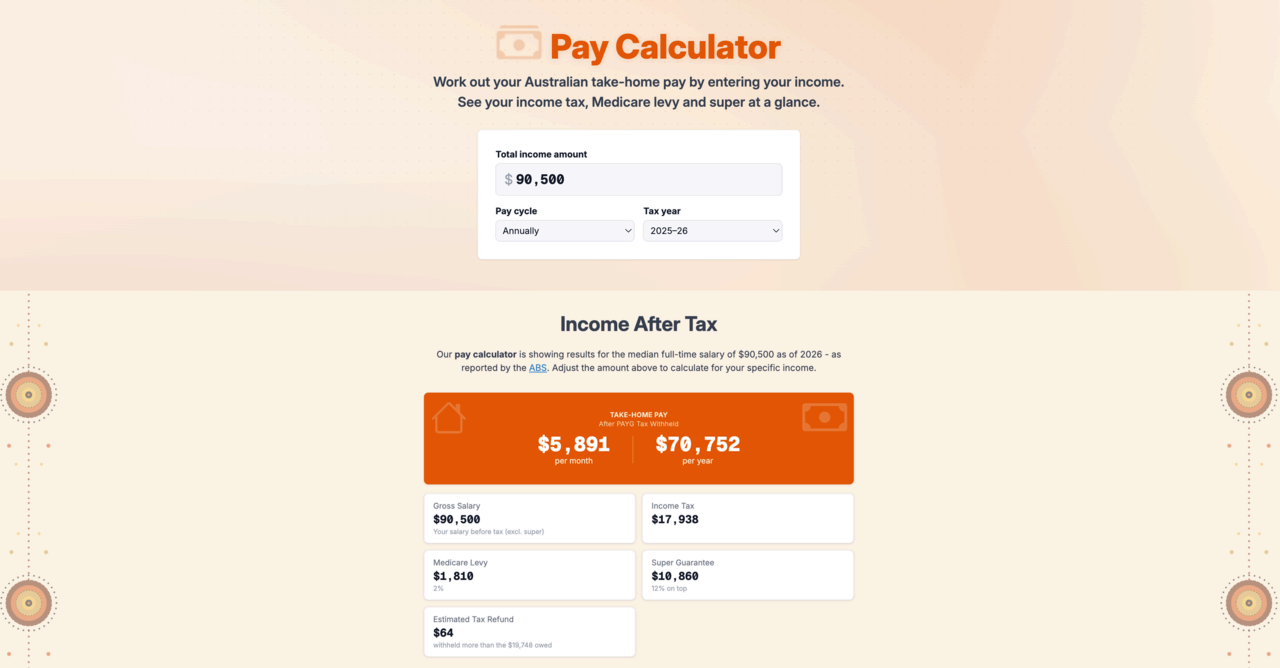
Introducing the OzFinn Pay Calculator: Know Exactly What Lands in Your Account
Most pay calculators answer one narrow question - how much tax do I pay? - and then leave you staring at a number with no idea what to do next. When I sat down to build the third tool in the OzFinn family, I wanted something that did more: tell you precisely what hits your bank account, show you why, make the answer effortless to share, and then connect your pay to the thing that actually matters - building wealth over time.
That's the OzFinn Pay Calculator. It joins our HISA comparison tool and ETF comparison tool as a free, fast, no-sign-up way to understand your money in Australia.
Here's what makes it different.
Built on two non-negotiables: simplicity and accuracy
A good tool earns trust the moment your number matches your payslip. So accuracy came first.
The Pay Calculator uses the official ATO PAYG withholding coefficients - the same formulas your employer runs every pay run. Enter your income, choose your pay cycle (annually, monthly, fortnightly, weekly, daily or hourly), pick your tax year, and the monthly take-home figure should line up with what actually arrives in your account. For most people with a single job, it does, to the dollar.
Everything else is deliberately stripped back. One input - your income. No fifteen-field forms, no toggles you don't understand, no pop-ups.
This tool also cover the years people actually search for: recent financial years back to 2020–21, plus forward estimates for 2026–27 and 2027–28 so you can plan ahead. And rather than hide our assumptions, we state them on the page - the figures assume an Australian resident for tax purposes, no HECS-HELP debt, and exemption from the Medicare levy surcharge. Honesty about the edges is part of accuracy, not a footnote to it.
A full tax breakdown - calculated for you, automatically
Knowing your take-home pay is useful. Understanding where the rest went is what turns a calculator into a learning tool.
The Pay Calculator breaks your income down at a glance:
- Take-home pay (per month and per year)
- Gross salary before tax
- Income tax withheld
- Medicare levy
- Super guarantee paid on top
- An estimated refund or bill at tax time
Below that sits a companion Tax Calculator that does something most tools skip: it shows your income mapped across each marginal bracket — how much is taxed at 0%, at 16%, at 30%, and so on - with the Medicare levy added on top.
Then it does the one calculation almost everyone gets wrong by hand: your effective tax rate. Plenty of people believe that because they've "crossed into the 30% bracket," they pay 30% on everything. They don't. The effective rate shows the actual share of your income that goes to tax once every bracket is accounted for - and it's almost always lower than people fear. Seeing that number, automatically, tends to be the moment the whole system finally clicks.
Share a result with a single copy-and-paste
This is the feature I'm quietly proudest of, because it sounds small but it is something that no-one else is doing.
Every input is fully encoded in the URL. Automatically. The income amount, the pay cycle, the tax year - all of it lives in the web address. So when you want to send a take-home figure to your partner, sanity-check an offer against HR, settle a debate in a forum, or compare two job offers side by side, you don't screenshot anything or re-explain your inputs. You copy the link and paste it. Whoever opens it sees the exact same breakdown you did.
No accounts. No "let me walk you through what I entered." Just a link that carries the whole answer with it.
From take-home pay to real wealth: the Wealth Calculator
Here's where the Pay Calculator stops being a tax tool and starts being a finance tool.
Your take-home pay isn't the finish line - it's the raw material. So underneath your results sits a Wealth Calculator that asks a simple, motivating question: what if you invested a slice of this?
It projects how 5%, 10% or 15% of your annual take-home pay could grow over the next 20 years, compounding at a rate you can adjust between 8% and 12%. The numbers are deliberately modest in their assumptions and refreshingly large in their conclusions - which is exactly the lesson compounding teaches. On a median income, consistently investing even a small percentage turns into a genuinely meaningful figure over a couple of decades.
It links straight through to our ETF comparison tool, so the path from "this is what I earn" to "this is how I could put it to work" is one click, not a research project. As always, it's an illustration of compounding, not financial advice - markets move, and the future is genuinely unknown.
Try it - it's free, and there's nothing to sign up for
The OzFinn Pay Calculator is live now. Plug in your number, see your real take-home pay, understand your tax, and get a glimpse of what consistent investing could build.
And if you want to round out the picture: park your savings somewhere that actually pays with the HISA comparison tool, and explore where to invest with the ETF comparison tool.